Abingdon, Oxfordshire
From Wikipedia, the free encyclopedia
| Abingdon | |
|
|
|
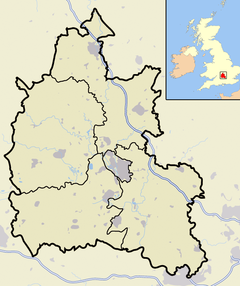  Abingdon shown within Oxfordshire |
|
| Population | 36,000 |
|---|---|
| OS grid reference | |
| - London | 62.6 m |
| Parish | Abingdon |
| District | Vale of White Horse |
| Shire county | Oxfordshire |
| Region | South East |
| Constituent country | England |
| Sovereign state | United Kingdom |
| Post town | ABINGDON |
| Postcode district | OX14 |
| Dialling code | 01235 |
| Police | Thames Valley |
| Fire | Oxfordshire |
| Ambulance | South Central |
| European Parliament | South East England |
| UK Parliament | Oxford West and Abingdon |
| List of places: UK • England • Oxfordshire | |
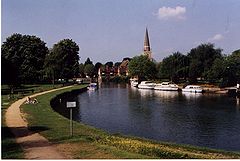
Abingdon (or archaically Abingdon-on-Thames) is a market town and civil parish in Oxfordshire in Southern England. It is the seat of the Vale of White Horse district. Previously the county town of Berkshire, Abingdon is one of several places which claim to be Britain's oldest continuously occupied town.[1]
Contents |
[edit] Geography and Transport
Abingdon is eight miles (13 km) south of Oxford, in the flat valley of the Thames and is situated on the west (right) bank of that river, where the small river Ock flows in from the Vale of White Horse. The town is situated on the A415 between Witney and Dorchester and has the benefit of being adjacent to the A34 trunk road, linking it with the M4 and M40 motorways. The B4017 and A4183 also link traffic into the town – both of these roads being part of the old A34 and often heavily congested.
Local bus services to Oxford and the surrounding areas are run by Stagecoach Oxfordshire, Thames Travel and the Oxford Bus Company as well as a number of smaller independent companies. The nearest minor railway stations are at Culham and Radley, although more frequent services may be caught at Oxford or Didcot Parkway.
[edit] History
The site has been occupied from the early to middle Iron Age and the remains of a late Iron Age defensive enclosure (or oppidum) lies below the town centre. The oppidum was in use throughout the Roman occupation.
Abingdon Abbey was founded in Saxon times, possibly the 7th century but its early history is confused by numerous legends, invented to raise its status and explain the place-name. The name seems to mean 'Hill of a man named Æbba, or a woman named Æbbe'[2], but Abingdon stands in a valley and not on a hill. It is thought that the name was first given to a place on Boars Hill above Chilswell, and the name was transferred to its present site when the Abbey was relocated[3].
In 1084, William the Conqueror celebrated Easter at the Abbey and then left his son, the future Henry I, to be educated there.
In the 13th and 14th centuries, Abingdon was a flourishing agricultural centre with an extensive trade in wool and a famous weaving and clothing manufacturing industry. The abbot seems to have held a market from very early times and charters for the holding of markets and fairs were granted by various sovereigns, from Edward I to George II. In 1337 there was a famous riot in protest at the Abbot's control of this market in which several of the monks were killed.
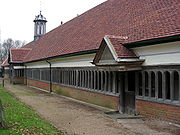

After the abbey's dissolution in 1538, the town sank into decay and, in 1555, upon receiving a representation of its pitiable condition, Mary I granted a charter establishing a mayor, two bailiffs, twelve chief burgesses and sixteen secondary burgesses, the mayor to be clerk of the market, coroner and a Justice of the Peace. The present Christ's Hospital originally belonged to the Guild of the Holy Cross, on the dissolution of which Edward VI founded the almshouses instead, under its present name.
The council was empowered to elect one burgess to parliament and this right continued until the Redistribution of Seats Act of 1885. A town clerk and other officers were also appointed and the town boundaries described in great detail. Later charters, from Elizabeth I, James I, James II, George II and George III, made no considerable change. James II changed the style of the corporation to that of a mayor, twelve aldermen and twelve burgesses.
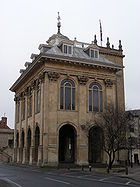
In 1790, Abingdon Lock was built, bringing navigation to the town instead of via the Swift Ditch. In 1810, the Wilts and Berks Canal opened, linking Abingdon with